News
Saudi Commercial Property Is Outpacing Residential
Saudi commercial property is doing something the residential market is not: rising. Kingdom-wide, commercial values sit around 13.5% above their 2023 base while homes sit at almost exactly 100, and over the last year commercial gained roughly 3.6% while residential eased by about 2.2%. Two markets, one country, opposite directions.
This is one of the more useful signals in the Saudi market right now, and it is largely absent from the coverage.
The split, in numbers
Using the official quarterly indices, where 2023 = 100:
| Segment | Latest index | Year on year | Since early 2021 |
|---|---|---|---|
| Commercial | 113.5 | +3.6% | +36.9% |
| Commercial plots | 114.0 | +3.5% | +37.6% |
| Buildings | 111.2 | +5.7% | +38.9% |
| General index | 103.5 | -0.7% | +27.2% |
| Residential | 100.0 | -2.2% | +23.9% |
Commercial has not only outperformed recently, it has outperformed across the whole five-year run: up nearly 37% since early 2021 against about 24% for homes. The gap widened sharply through 2024 and 2025.
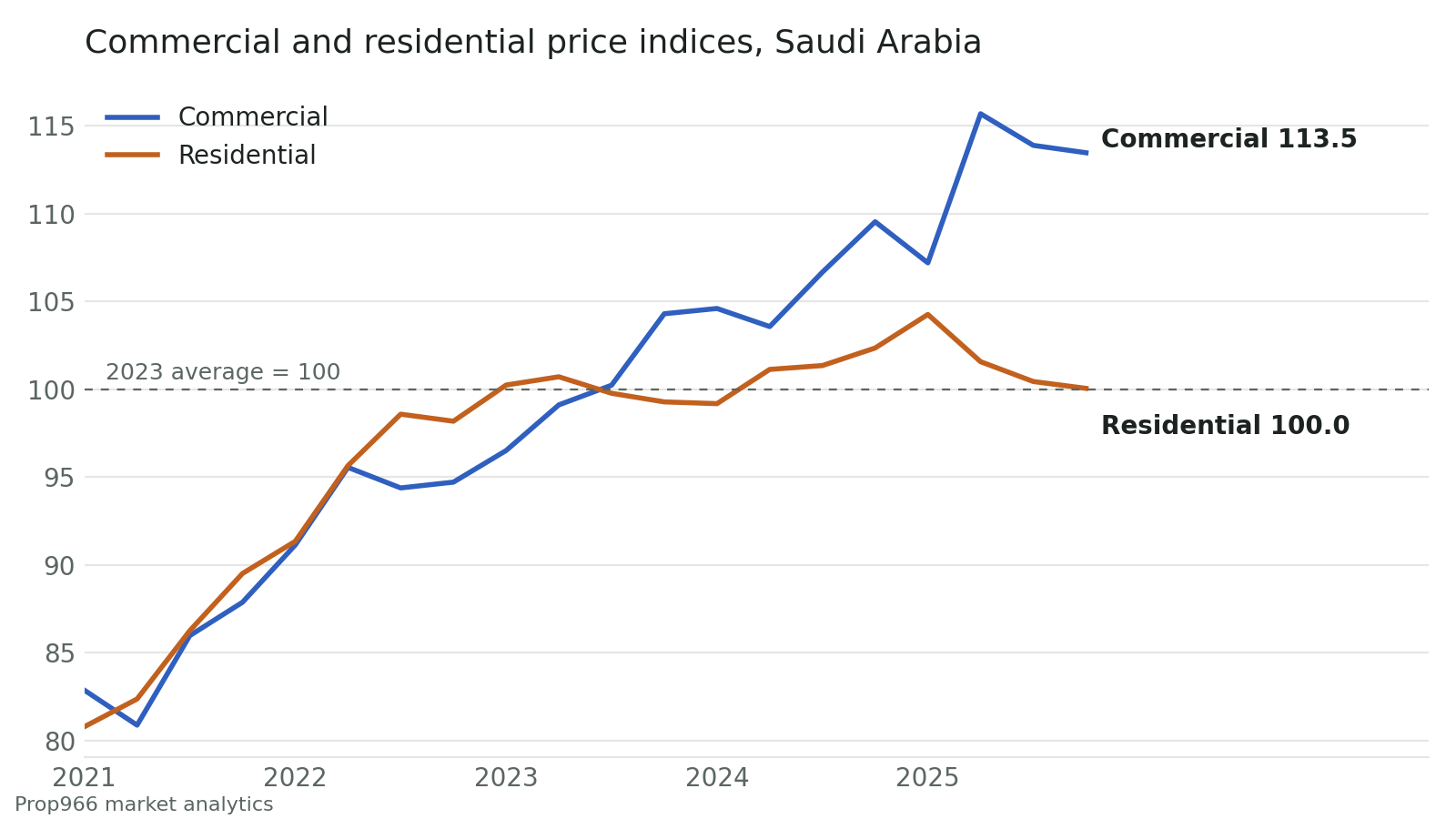
The most recent official quarterly release points the same way, with commercial values up around 3.4% year on year while the residential sector eased.
Why the two markets separated
The explanation is supply, not sentiment.
Housing has been the priority, so housing is what got built. The Kingdom’s home-ownership targets have driven an extraordinary volume of new residential delivery: state housing programmes, subsidised routes for citizens, and master-planned communities around every major city. Tens of thousands of homes have entered the market in Riyadh alone. When the supply of anything expands that fast, its price stops climbing. That is not weakness, it is the policy working.
Commercial space has faced the opposite dynamic. Companies establishing regional headquarters, an expanding logistics sector, and retail following population growth have all added demand for offices, warehouses and shops, without a comparable wave of new supply arriving at the same moment. Prices did what prices do when demand outruns delivery.
Notice which segments lead the commercial table: plots and buildings, up around 37% and 39% since 2021, against just over 6% for shop and gallery units. It is the land and the structures that are repricing, which is the signature of businesses competing for space to build and occupy rather than of retail rents inflating.
What it means if you are buying a home
Three practical readings, and none of them argues against buying residential.
First, the economic story is intact. Commercial values rise when businesses commit capital to locations. Businesses committing capital means jobs, and jobs mean housing demand. A residential buyer looking at flat home prices could read them as a warning; read alongside commercial strength, they look instead like the supply side doing its job while the demand side keeps building underneath.
Second, your negotiating position is unusually good. You are buying in the segment where supply is most abundant, at a point in the cycle where prices are consolidating. That combination has not existed in this market for five years. The detail is in our analysis of Saudi price movements.
Third, location logic follows the commercial map. Districts attracting offices, logistics and retail investment today are where residential demand pressure lands next. That is worth more than any general forecast when you are choosing between two areas.
What it means if you are considering commercial
The index performance is genuinely attractive, but the practical barriers are real: higher entry prices, thinner liquidity, and tenant risk concentrated in a single lease rather than spread across a rental market. Commercial also demands a different diligence process, and foreign ownership rules apply to commercial assets on their own terms.
For most individual investors entering Saudi Arabia, residential remains the accessible route, with the ordinary protections in place: escrow through the licensed off-plan framework, explained in how Wafi escrow works, and the purchase sequence set out in our off-plan buying guide.
The read
A market where commercial climbs and housing consolidates is not a market losing momentum. It is a market where the housing programme is delivering and the economy is absorbing space. For a residential buyer, that is close to the ideal combination: evidence of growth on one side of the ledger, and negotiating room on the other.
Property investment carries risk and index data is information rather than financial advice. Verify project licensing and your ownership eligibility before committing funds.
Update, Q2 2026: the market has since turned higher, with the index up 1.3% year on year and 3% on the quarter. See our Q2 2026 market update.
References
Figures in this article are computed from official Saudi market statistics (GASTAT, REGA) via Prop966 market analytics, including data to Q1 2026.
Frequently Asked Questions
Is commercial property a better investment than residential in Saudi Arabia?
On price index performance, commercial has outpaced residential: it sits around 13.5% above its 2023 base against roughly parity for homes, and it rose about 3.6% over the most recent year while residential eased. That reflects different supply dynamics rather than a verdict on either, and commercial carries higher entry costs and less liquidity.
Why is Saudi commercial property rising while home prices ease?
Homes are the segment receiving the largest wave of new supply, from state housing programmes and master-planned communities, which naturally moderates prices. Commercial space is being absorbed by an economy adding offices, logistics and retail as companies establish and expand in the Kingdom, and that supply has not expanded as quickly.
What does the commercial market tell residential buyers?
It is a demand signal. Rising commercial values indicate businesses committing to locations, which means jobs, which eventually means housing demand around those districts. A residential buyer can read commercial strength as evidence that the underlying economic growth story is intact.