News
Are Saudi Property Prices Falling? 2026 Data
Saudi Arabia property prices fell 1.6 percent in the year to the first quarter of 2026. They are also about 27 percent higher than they were at the start of 2021. Both sentences are true. Only one of them makes a headline.
If you are trying to decide whether this is a market to enter or a market to avoid, neither sentence on its own is much use. So here is the full picture, from the official price index data: what is actually falling, what is still rising, and what the difference means if you are buying.
Key takeaways
- The general real estate price index stood at 103.3 in Q1 2026, down 1.6 percent year on year but still 3.3 percent above the 2023 average and roughly 27 percent above early 2021.
- The dip is residential: villas down 6.1 percent and residential land down 3.9 percent year on year in Q1 2026, while apartments slipped just 1.1 percent.
- Commercial property moved the other way, up 3.4 percent over the same period. This is not a market falling. It is a market rotating.
- For buyers, a flat market after a five year climb mostly means one thing: negotiating room, arriving at the same time as the Kingdom’s new foreign ownership rules.
What the Saudi real estate price index shows
The Saudi Arabia real estate price index is the official quarterly measure of property price changes across the Kingdom, published with 2023 as the base year. A reading of 100 means prices match the 2023 average. A reading of 103.5 means prices are 3.5 percent above it. The index tracks actual market movement, not asking prices, which makes it slower than listing portals and considerably harder to argue with.
The long view is a climb: from 81.4 in the first quarter of 2021 to 103.5 by the end of 2025, a rise of about 27 percent in five years. The climb was steepest through 2021 and 2022, flattened through 2023 and 2024, peaked at 105.0 in mid 2025, and has been easing gently since.
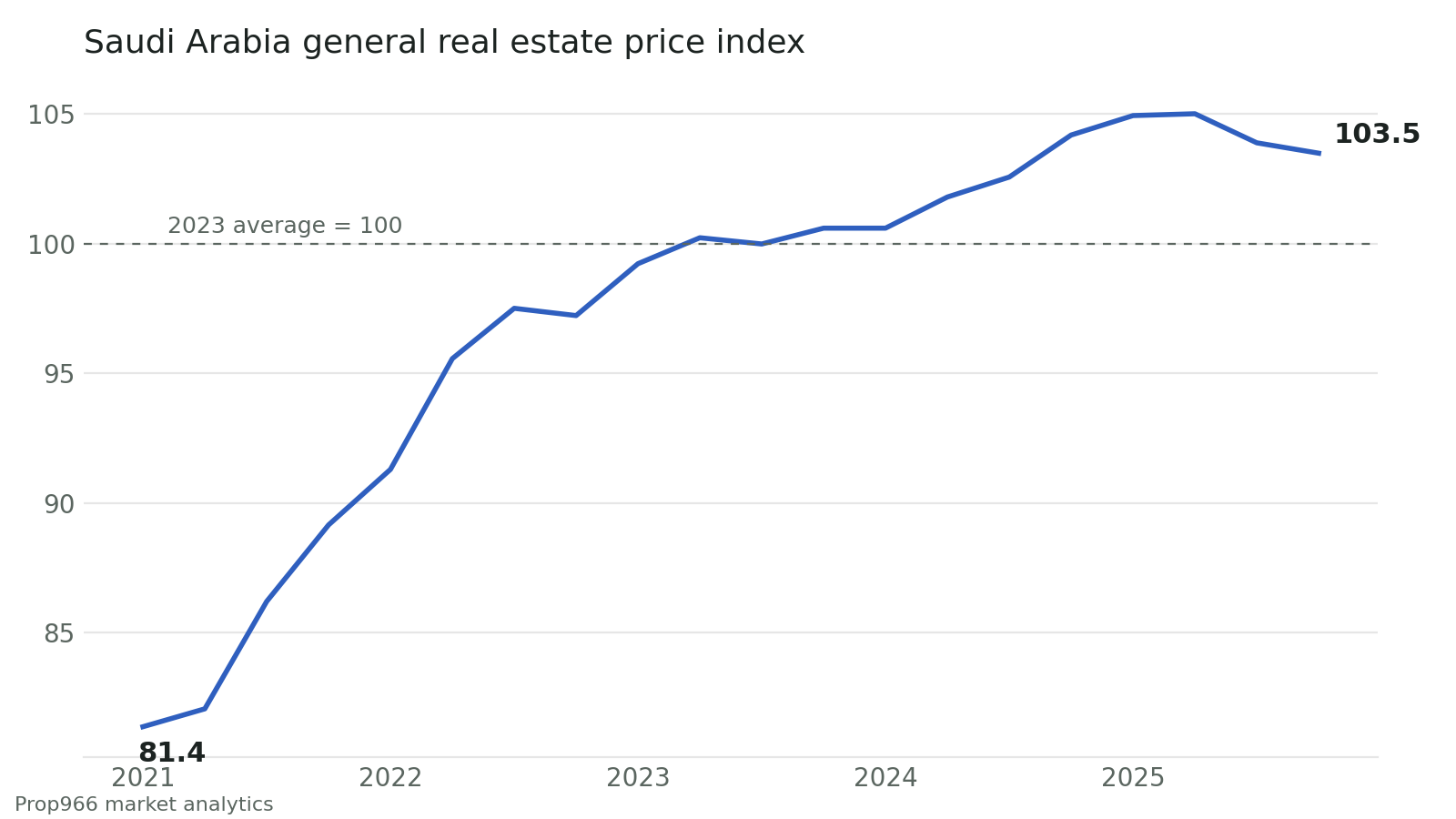
So the honest answer to “rising or falling” is: prices spent five years rising, and have spent about a year drifting sideways with a slight downward tilt. All of that alarm, for one point six percent.
Saudi house prices in 2026: the actual numbers
The Q1 2026 release puts the general index at 103.3, down 1.6 percent year on year. The decline sits almost entirely in the residential sector, which carries 72.7 percent of the index weight and fell 3.6 percent. Inside that number:
- Residential land: down 3.9 percent
- Villas: down 6.1 percent
- Apartments: down 1.1 percent
- Residential floors: up 0.6 percent
Commercial property rose 3.4 percent over the same year. So the sector that houses businesses got more expensive while the sector that houses people got slightly cheaper, which is roughly what you would expect from an economy adding offices, logistics and retail faster than its citizens are bidding up homes.
The pattern matters more than the headline. A market where everything falls together is demand disappearing. A market where land and villas ease while apartments barely move and commercial climbs is something else: the supply side finally showing up.
Villa prices vs apartments: the divergence
Villas have been the strongest residential segment of the past five years, and they are also where the current easing is concentrated. On the index, villas peaked at 105.0 in mid 2025 and closed the year at 103.2, about 1.3 percent below a year earlier. Apartments have been drifting longer and sit at 98.9, just below their 2023 average and 2.5 percent down year on year.
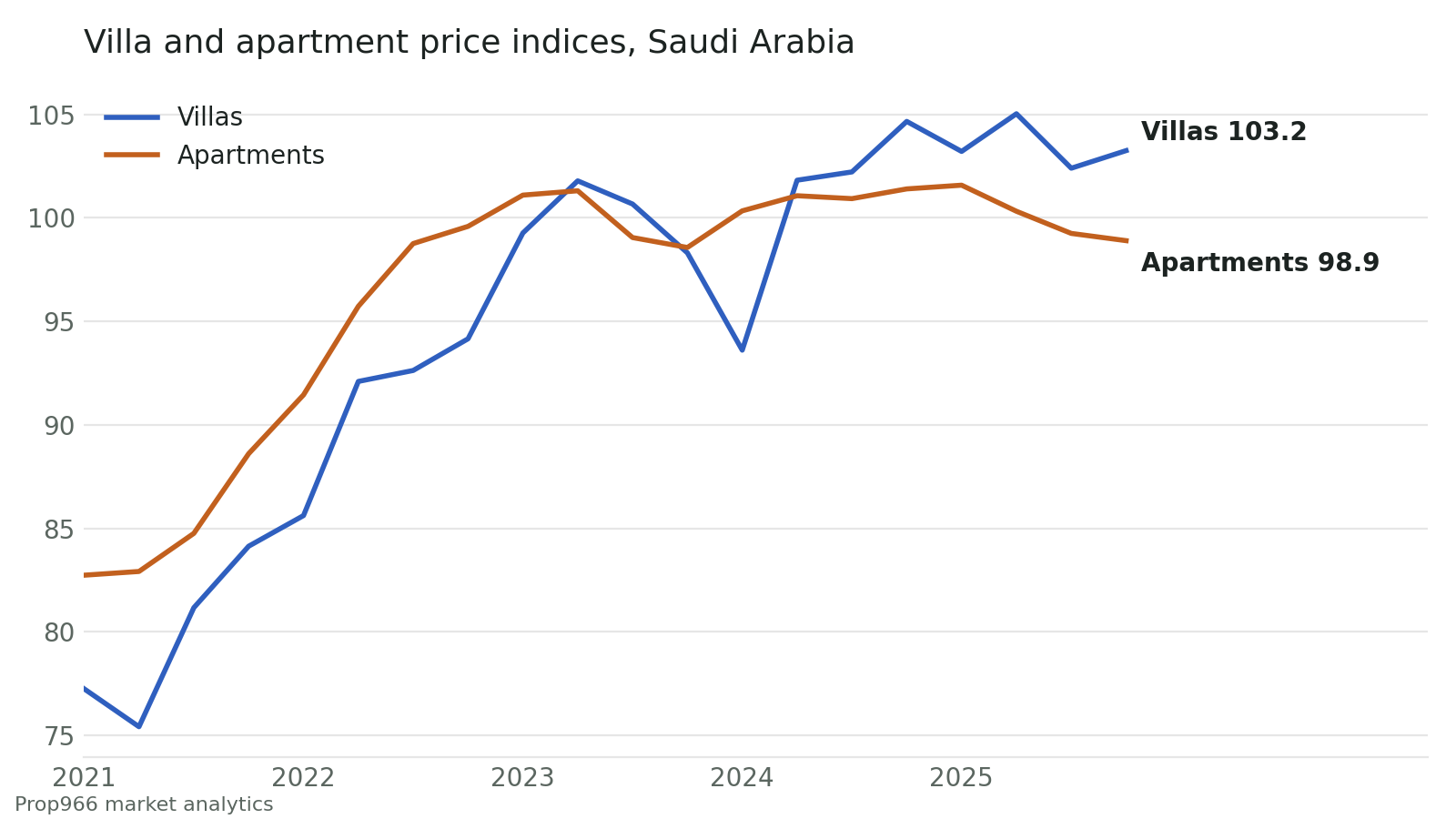
The villa story is a supply story. Villas and the land under them led the boom, which is precisely why the Kingdom’s housing programme has spent the years since pouring villa and townhouse supply into master planned communities around the major cities. When the product that rose the most is also the product being delivered at the greatest scale, its price cooling first is not a mystery. Prices did not stop rising because buyers vanished. They stopped rising because houses showed up.
What the 2026 market actually looks like
Three things are true about the Saudi Arabia real estate market in 2026, and they point in different directions, which is why single number headlines mislead.
First, prices are consolidating after an exceptional run. A 27 percent five year climb followed by a 1.6 percent annual dip is not a reversal. It is a plateau. The index would need to fall more than twenty points just to get back to where it started in 2021, and nothing in the sector data suggests movement of that kind.
Second, the construction pipeline has not blinked. Vision 2030 delivery continues across Riyadh, Jeddah and the giga project sites, backed by public investment on a scale no comparable market enjoys. New supply is exactly what the residential numbers show arriving, and supply arriving on schedule is what a development programme succeeding looks like.
Third, the buyer pool is widening. Since January 2026, foreigners can buy property in designated ownership zones for the first time, under the ownership law that took effect this year. A price plateau arriving in the same year the market opens to international buyers is, for those buyers, reasonable timing.
For the regulatory detail, the official sources are the General Authority for Statistics for the index itself and the Real Estate General Authority for market rules.
What this means if you are buying
A flat market rewards preparation differently than a rising one. In 2021 the cost of hesitating was paying more next quarter. In 2026 the cost of hesitating is close to zero, which shifts the advantage to buyers who do the unglamorous checks properly.
- Negotiate like the index is on your side, because it is. A seller in a market drifting down 1.6 percent a year has a different patience level than one watching prices climb. On off-plan launches, that patience shows up as payment plan flexibility more often than sticker discounts.
- The index is national. Your purchase is not. These figures are kingdom wide aggregates. A single district can run well ahead of or behind the national line, so treat the index as context, not as a valuation of the unit in front of you.
- The process protections matter more when you are early. Off-plan purchases in Saudi Arabia run through the Wafi escrow system, where payments sit in a supervised account and are released against construction progress. How that works, step by step, is in our off-plan buying guide.
- Budget the full cost, not the sticker. Add the 5 percent Real Estate Transaction Tax on top of the purchase price. On a SAR 2 million home that is SAR 100,000, due at transfer, and it does not care what the index did this quarter.
- If you are buying in Riyadh, read the zone rules first. Foreign eligibility is district by district, not city wide. Start with the Riyadh area guide before shortlisting.
Off-plan investment carries risk, and a price index is information, not financial advice. Verify every project’s licence and zone status before committing money.
Update, Q2 2026: the market has since turned higher, with the index up 1.3% year on year and 3% on the quarter. See our Q2 2026 market update.
References
Figures in this article are computed from official Saudi market statistics (GASTAT, REGA) via Prop966 market analytics, including data to Q1 2026.
Frequently Asked Questions
Are property prices falling in Saudi Arabia?
Slightly, yes. The official index fell 1.6 percent in the year to Q1 2026, driven by villas and residential land. But prices remain about 27 percent above early 2021 and 3.3 percent above the 2023 average, so the accurate description is a plateau after a long climb, not a slump.
Why are villa prices falling in Saudi Arabia?
Villas rose more than any other residential segment during the boom, and they are also where new supply is concentrated as master planned communities deliver at scale. Prices easing 6.1 percent in the year to Q1 2026 reflects that supply arriving, not a collapse in demand for villas.
Is 2026 a good time to buy property in Saudi Arabia?
The data describes a buyer friendly moment: flat prices, motivated sellers, heavy new supply, and foreign ownership zones open since January 2026. Whether it is right for you depends on your district, financing and horizon. Verify Wafi licensing and zone eligibility before deciding, and treat this as information rather than advice.
Will Saudi property prices rise again?
No one can promise a price path. What the data shows is a market with continuing population growth, a state backed construction programme, commercial prices already rising 3.4 percent a year, and a newly widened buyer pool. Those are the conditions that historically support prices, but they are conditions, not guarantees.